Choosing between MNQ (Micro E-mini Nasdaq Futures) and NQ (E-mini Nasdaq Futures) depends on your trading capital, risk tolerance, and strategy. Here’s what you need to know:
- Size Difference: MNQ is 1/10th the size of NQ. MNQ’s tick value is $0.50, while NQ’s is $5.00.
- Margin Requirements: MNQ requires lower margins (starting at $50), making it suitable for smaller accounts. NQ typically requires $500 or more.
- Risk Management: MNQ allows for finer position sizing and lower dollar risk per trade. NQ offers higher profit potential but with larger swings.
- Trading Costs: NQ is more cost-efficient for equivalent exposure, but MNQ provides flexibility for smaller accounts.
- Liquidity: NQ has deeper order books and tighter spreads, ideal for high-frequency traders. MNQ is also liquid but may have slightly wider spreads during volatility.
Quick Comparison
| Feature | MNQ (Micro E-mini Nasdaq) | NQ (E-mini Nasdaq) |
|---|---|---|
| Contract Multiplier | $2 per index point | $20 per index point |
| Tick Value | $0.50 | $5.00 |
| Day Trading Margin | $50+ | $500+ |
| Liquidity | Solid | Higher |
| Best For | Small accounts, beginners | Larger accounts, scalpers |
Bottom line: MNQ is ideal for smaller accounts and precise risk management, while NQ suits experienced traders with larger capital. Both track the Nasdaq-100, so your choice depends on your goals and resources.

MNQ vs NQ Futures Contract Comparison Chart
Contract Specifications: MNQ vs NQ
Contract Multiplier, Tick Size, and Value
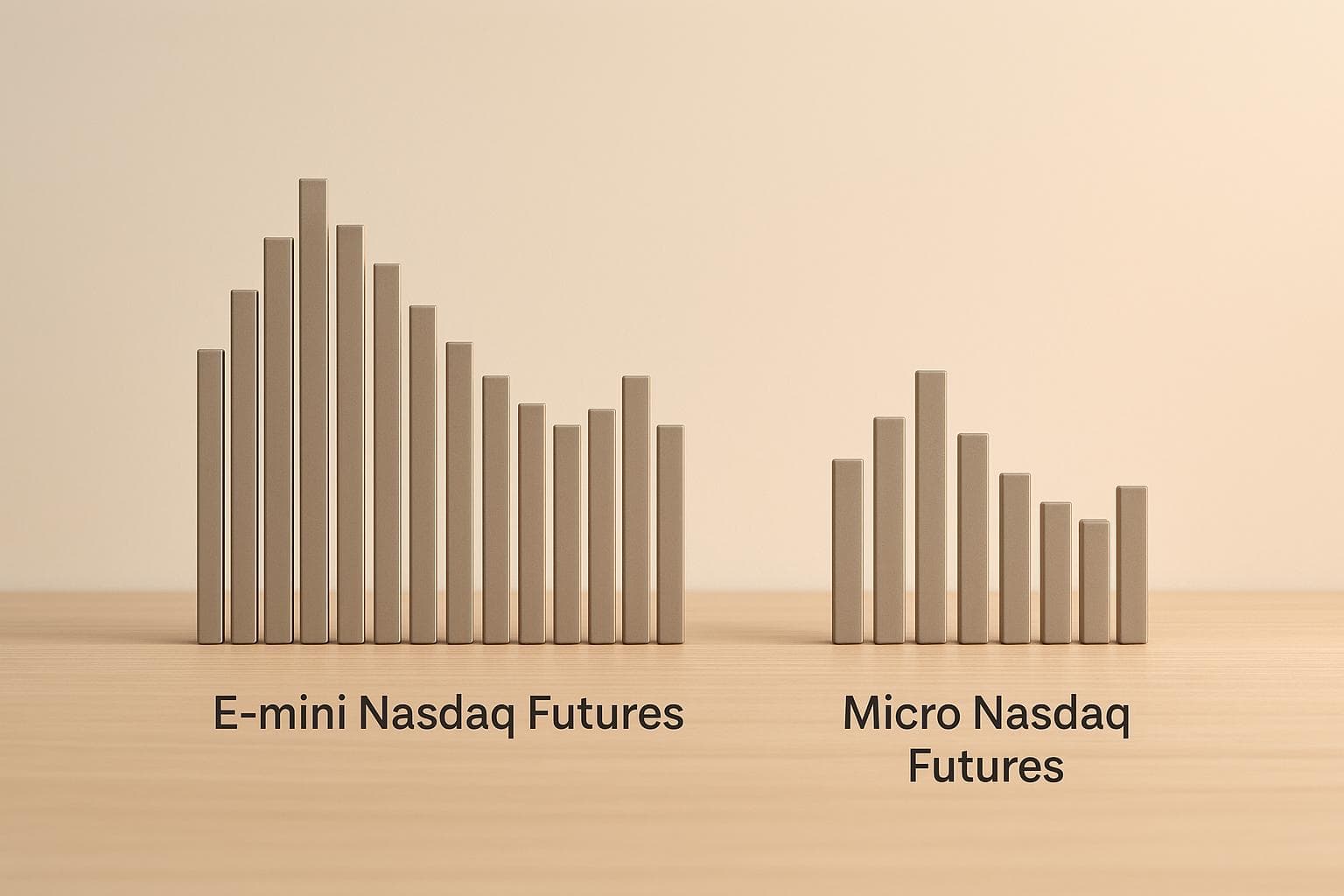
The main distinction between these two contracts lies in their size. The NQ contract has a multiplier of $20 per index point, while the MNQ is just $2 per index point – making the MNQ exactly one-tenth the size of the NQ.
While both contracts share a tick size of 0.25 index points, the monetary impact varies: each tick is worth $5.00 for the NQ and $0.50 for the MNQ. This difference directly affects profit and loss with every market movement.
Here’s a side-by-side comparison of their key features:
| Feature | E-mini Nasdaq-100 (NQ) | Micro E-mini Nasdaq-100 (MNQ) |
|---|---|---|
| Contract Multiplier | $20 x Nasdaq-100 Index | $2 x Nasdaq-100 Index |
| Tick Size | 0.25 index points | 0.25 index points |
| Tick Value | $5.00 | $0.50 |
| Value per 1 Index Point | $20 | $2 |
| Notional Value (Index at 15,500) | $310,000 | $31,000 |
| Trading Hours (CME Globex) | Sunday 6:00 p.m. – Friday 5:00 p.m. ET (with daily 5–6 p.m. ET maintenance) |
Sunday 6:00 p.m. – Friday 5:00 p.m. ET (with daily 5–6 p.m. ET maintenance) |
For example, if the Nasdaq-100 Index moves 100 points, the outcome would look like this:
- NQ Contract: Gain or loss of $2,000 (400 ticks x $5.00 per tick).
- MNQ Contract: Gain or loss of $200 (400 ticks x $0.50 per tick).
These distinctions directly influence trading decisions, from managing price movements to setting strategies.
How Contract Size Affects Your Trading
Grasping the difference in contract sizes is crucial for managing risk effectively. The smaller size of the MNQ allows for finer adjustments and reduces the dollar risk per contract. This flexibility is particularly useful for traders working within strict account limits.
Take a $100,000 account, for instance, with a risk tolerance of 0.5% per trade ($500). Using one NQ contract, you’d be limited to a 25-point stop loss. However, with the MNQ, you could absorb a 250-point move under the same $500 risk, offering much greater flexibility.
Trailing drawdown limits also highlight the difference. With a 6% trailing drawdown (a $6,000 cushion), a 300-point adverse move on an NQ contract would result in a $6,000 loss – potentially breaching the account limit. By comparison, the same 300-point move with an MNQ contract would lead to just a $600 loss, leaving room to manage exposure and stay within limits.
This level of control is especially valuable for traders looking to scale positions gradually or adjust exposure dynamically as market conditions shift.
Trading Costs, Margins, and Liquidity
Commission and Fee Comparison
Even though many brokers promote zero-commission trading, clearing fees still apply and vary between contracts. For the NQ, the round-turn clearing fee is $2.80, while for the MNQ, it’s $0.74.
If you’re aiming for equivalent market exposure, trading ten MNQ contracts will cost $7.40 in fees, compared to just $2.80 for a single NQ contract. From a fee perspective, the NQ is more economical when trading equivalent positions.
However, the MNQ provides flexibility that the NQ doesn’t. You’re not locked into trading in blocks of ten contracts. Instead, you can fine-tune your position size to suit your risk tolerance and account size, even if it means slightly higher fees per unit of exposure. These differences in fees directly tie into the contrasting margin requirements of each contract.
Margin Requirements for Each Contract
Margins for the MNQ are only one-tenth of those for the NQ. For example, MNQ day trading margins start as low as $50, while the NQ requires $500 or more at most brokers.
"Lower margin lets you trade more contracts or keep more cash in reserve for active strategies." – Optimus Futures
This lower margin requirement is a game-changer for traders with accounts under $10,000. It allows for effective risk management without tying up a large amount of capital. With the MNQ, you can set appropriate stop losses, whereas trading the NQ might force you to compromise between overly tight stops or risking too much capital. For swing traders holding positions overnight, the smaller margin requirements also make it less expensive to carry positions over multiple days or weeks.
Liquidity and Order Execution
The NQ generally boasts deeper order books and tighter bid-ask spreads, thanks to its widespread institutional use. For example, on December 14, 2025, at 7:54 AM CT, the NQ had a volume of 88,747 contracts, compared to 80,682 for the MNQ earlier that same morning.
"E-mini contracts have deeper order books and tighter spreads due to broader institutional adoption." – FundedNext Blog
For scalpers and day traders who make frequent trades, the NQ’s superior liquidity can help minimize slippage and improve execution quality. While the MNQ is also liquid and has seen steady growth since its launch in May 2019, it occasionally experiences slightly wider spreads during periods of high market volatility. That said, for position traders or those holding contracts over longer timeframes, the difference in liquidity is usually negligible.
Risk Management and Position Sizing
Fine-Tuning Position Sizing with MNQ
The MNQ offers a level of flexibility that’s hard to achieve with the larger NQ. With adjustments possible in $2 increments (compared to $20 for the NQ), it’s especially useful for traders managing accounts in the $5,000 to $10,000 range while adhering to a 1–2% risk rule.
This flexibility allows traders to scale into and out of positions gradually, adding or subtracting contracts as prices move. For example, you could start with an NQ position and fine-tune your exposure by adding MNQ contracts. This approach also improves stop-loss placement, letting traders focus on technical levels rather than being constrained by account size or capital limitations.
Managing Stop-Loss Placement Amid Volatility
The Nasdaq-100’s natural volatility makes stop-loss placement tricky, but the MNQ provides a practical solution. A 50-point stop-loss on the MNQ costs $100, compared to $1,000 on the NQ. This means traders can set stops at meaningful technical levels without blowing past their risk limits. For a $10,000 account with a 1% risk cap ($100 per trade), trading the NQ would force you into a tight 5-point stop – too narrow to handle typical market swings.
With the MNQ, you’re no longer tied to stops dictated by account size. Instead, you can align them with key support or resistance levels, maintaining both risk control and technical accuracy.
P&L Swings and Emotional Control
The MNQ’s smaller tick value can make a big difference in managing the psychological side of trading. The NQ’s larger tick size leads to rapid swings in profit and loss, which can trigger emotional reactions – fear when losses escalate quickly or overconfidence when profits spike.
In contrast, the MNQ softens these swings, reducing emotional stress and encouraging better discipline. For instance, a 20-point move against your position equals a $40 change on the MNQ, compared to a $400 shift on the NQ. For smaller accounts, this means you can place stops at appropriate levels without risking too much of your capital. The result? More consistent execution and steadier decision-making, free from the emotional roller coaster of larger P&L swings.
sbb-itb-24dd98f
Micro Nasdaq Futures – Differences between the MNQ and NQ
Hardware Requirements for MNQ and NQ Trading
When trading MNQ and NQ futures, having the right hardware is crucial. Fast execution and precise risk management depend heavily on your system’s ability to handle real-time data efficiently.
Computer Specs for Active Futures Trading
Trading MNQ and NQ futures demands a computer that can process data quickly and reliably. Here’s what you’ll need:
- Processor: A multi-core CPU to handle continuous data processing without lag.
- Memory: At least 32GB of RAM to support multiple charts, tools, and trading platforms running simultaneously.
- Storage: A high-speed NVMe SSD for quick order execution and seamless performance.
For scalpers, where even a millisecond delay can turn a profit into a loss, high-performance hardware is non-negotiable. For example, DayTradingComputers‘ Pro model comes equipped with 64GB DDR5 RAM and a 2TB NVMe SSD, offering the power and capacity to manage multiple charts and tools effortlessly. An optimized display setup is equally vital for keeping track of several data streams at once.
Multi-Monitor Setups for Futures Traders
Futures traders often need to monitor execution charts, various timeframes, and live news feeds simultaneously. A dual-monitor setup is a practical solution for this. Whether you’re trading a single MNQ contract or managing multiple NQ contracts, a reliable GPU is essential to ensure smooth performance across multiple screens. Many systems from DayTradingComputers include high-performance GPUs like the NVIDIA GeForce RTX 4070 Ti SUPER, which can handle demanding trading platforms and multi-display setups with ease.
Low Latency and Platform Reliability
Low latency is critical in NQ trading, where tighter spreads and high liquidity leave little room for error. While MNQ futures also offer liquidity, they may occasionally show slightly wider spreads during rapid market movements. Since futures markets operate nearly 24 hours a day during the trading week, having a reliable system is non-negotiable. A hardware failure during an open position can lead to significant financial losses. To address this, DayTradingComputers provides stable, pre-tested hardware with Windows 11 pre-installed, minimizing the chances of platform failures during crucial trading hours.
Conclusion: Which Contract Is Right for You?
Let’s break down the key points to help you decide between MNQ and NQ based on your trading goals and resources.
Key Differences Between MNQ and NQ
The main distinction lies in their size and margin requirements. MNQ is 1/10th the size of NQ, with a tick value of $0.50 compared to NQ’s $5.00. This makes MNQ a more accessible option for traders with limited capital, as day trading margins can start as low as $50, while NQ usually requires $500 or more.
NQ, on the other hand, stands out for its tighter spreads and superior liquidity, making it a go-to for scalpers and high-frequency traders. MNQ still offers competitive spreads of 1–2 ticks and solid retail liquidity, all while tracking the same Nasdaq-100 Index. These differences are crucial for aligning your trading strategy with the right contract size.
Choosing the Best Contract for Your Trading Style
If you’re new to trading or working with an account under $10,000, MNQ is a smart choice. It reduces risk while still providing scalable exposure, making it ideal for learning the ropes or managing precise hedges. For traders with over $25,000 in capital, NQ offers greater profit potential thanks to its tighter spreads and deeper liquidity. Plus, for high-volume trading, NQ tends to be more cost-efficient.
Experienced traders might benefit from using both contracts. For instance, NQ can serve as the backbone for core positions, while MNQ allows for fine-tuning exposure. This hybrid strategy leverages NQ’s liquidity with MNQ’s flexibility, enabling more precise risk management. Ultimately, the right choice depends on your trading capital, risk tolerance, and even the performance capabilities of your trading setup.
FAQs
What makes MNQ a better choice than NQ for beginner traders?
For those just starting out, Micro Nasdaq (MNQ) futures can be a smart choice compared to E-mini Nasdaq (NQ) futures. One key advantage is the lower capital requirement, which makes MNQ contracts more accessible for traders with smaller accounts. Plus, the smaller contract size helps limit the risk on each trade, giving new traders a better chance to manage their positions and keep potential losses in check.
Another big perk? MNQ allows more flexibility for trying out trading strategies. Beginners can test and fine-tune their methods without putting too much of their capital on the line. This makes it an ideal option for learning the ropes and building confidence in the futures market.
How does the liquidity of Micro Nasdaq (MNQ) compare to E-mini Nasdaq (NQ) during high market volatility?
During times of high market volatility, Micro Nasdaq (MNQ) futures tend to have less liquidity compared to E-mini Nasdaq (NQ) futures. This lower liquidity can lead to wider bid-ask spreads, making it harder to execute larger trades without influencing the market price.
For traders with smaller accounts, MNQ can still be a sensible option thanks to its smaller contract size. However, it’s important to stay mindful of potential slippage and rapid price changes during volatile periods. On the other hand, NQ’s greater liquidity makes it a better fit for larger trades or strategies that depend on tighter spreads.
Why would an experienced trader use both Micro Nasdaq (MNQ) and E-mini Nasdaq (NQ) futures in their strategy?
Experienced traders often leverage both MNQ and NQ contracts to strike a balance between managing risk and maintaining flexibility in their trading strategies. The smaller MNQ contracts are particularly useful for making precise adjustments to position sizes. This makes them a great choice for testing new strategies or controlling risk without tying up a lot of capital. Meanwhile, the larger NQ contracts offer greater exposure, which can enhance potential profits when traders feel confident about a trade.
Using a mix of these contract types allows traders to execute strategies like scaling in and out of positions, hedging, or pyramiding based on market conditions and their goals. This combination provides the ability to fine-tune positions in a way that aligns with account size, risk appetite, and overall trading plans.