A Forex VPS (Virtual Private Server) is a remote computer designed to run your trading software 24/7 without interruptions. Unlike your home computer, a VPS operates in a professional data center, ensuring reliability during power outages or internet issues. It reduces latency, improves order execution speed, and is especially useful for automated trading systems like Expert Advisors (EAs). By hosting your platform near your broker’s servers, a VPS minimizes delays and slippage, offering a stable and efficient trading environment.
Key Benefits:
- 24/7 Operation: Keeps your trading tools active even when you’re offline.
- Low Latency: Faster trade execution due to proximity to broker servers.
- Reliability: Unaffected by local power or internet disruptions.
- Optimized for Automation: Handles complex strategies without slowing down.
To set up, choose a VPS plan that matches your trading needs, connect via Remote Desktop, and configure your trading platform. Regular testing ensures smooth performance and minimal delays.
How a Forex VPS Works
VPS Architecture Basics
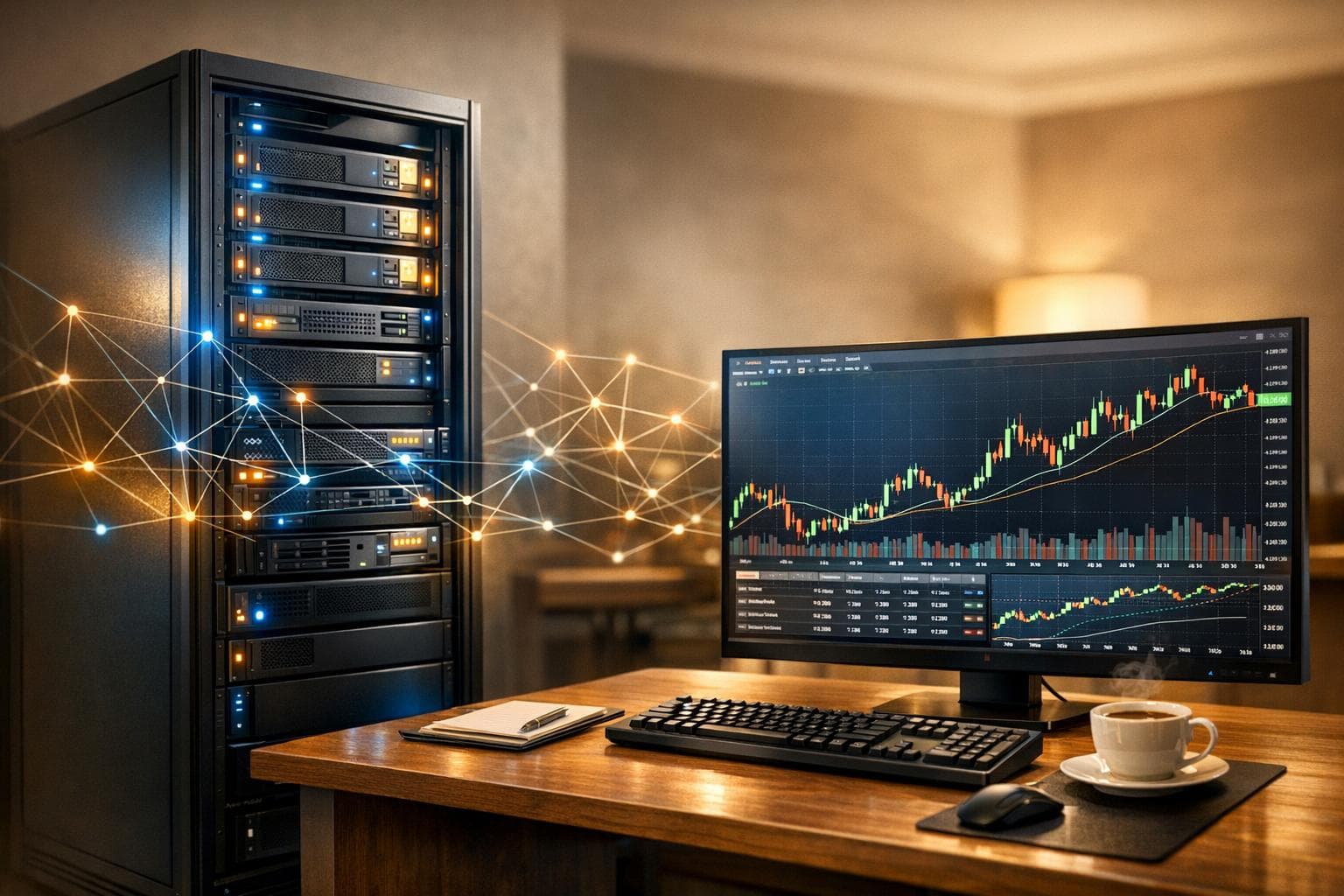
The structure of a Forex VPS is simple but highly effective. Using Remote Desktop Protocol (RDP), your home computer connects to a remote server housed in a professional data center. Think of it as having a dedicated, always-on trading computer that you can access from anywhere. This virtual machine operates its own operating system and hosts your trading platforms – most commonly MetaTrader 4 or MetaTrader 5 – along with any Expert Advisors (EAs) you’ve configured.
One standout benefit is its direct link to your broker’s server. This means your trading platform runs independently on the VPS, ensuring uninterrupted operations. Even if your home internet goes down or your computer powers off, your trades and automated strategies continue without skipping a beat. Essentially, the VPS acts as your private trading workstation, located in a secure facility designed for round-the-clock operation.
Latency and Order Execution
The VPS’s architecture is designed to tackle one of the most critical aspects of trading: latency. Latency refers to the time it takes for data to travel between your trading platform and your broker’s server. In trading, even a slight delay can make a big difference. By hosting your trading platform in data centers near major financial hubs and broker servers, a Forex VPS cuts this delay down to just milliseconds.
For those involved in high-frequency or multiple trade executions, this reduced latency can mean less slippage and better fill prices. During volatile market conditions, where prices can change in the blink of an eye, this speed advantage ensures your orders are executed as close to the expected price as possible. With such a stable, low-latency setup, your trading operations can run smoothly and efficiently.
How Traders Use a VPS
Thanks to its dependable architecture and ultra-low latency, a Forex VPS allows traders to manage their strategies effortlessly from virtually any device. Using Remote Desktop on Windows or Mac, you can connect to your VPS, install your trading software, and configure your EAs. Once everything is set up, the VPS ensures your strategies stay active, even if your local device is offline.
As Johnathon Fox, a Forex and Futures trader at Forex School Online, puts it: "Instead of either burning my computer or laptop all night, I choose to use someone else’s computer hardware who has a system that is built exactly for the job and who has backup systems in place so that if anything does go wrong, there are other servers to keep my indicator up and live in the market."
This setup gives you the freedom to log off your VPS without worry. Whenever you need to check your trades or tweak your strategies, simply reconnect using any internet-enabled device. It’s a flexible, secure, and efficient way to keep your trading operations running smoothly.
Benefits of Using a VPS for Forex Trading
Lower Latency and Reduced Slippage
In Forex trading, speed is everything. A Virtual Private Server (VPS) places your trading platform closer to your broker’s servers, cutting down the time it takes for data to travel. This proximity can reduce latency to as little as 1 millisecond. For traders who rely on quick decision-making, like scalpers and high-frequency traders, this can mean better trade execution and less slippage.
When markets are volatile or major news breaks, having a VPS with a dedicated high-speed connection ensures your trades execute smoothly. This consistency helps avoid performance hiccups during critical moments in the market.
24/5 Uninterrupted Operation
Trading doesn’t pause when you step away, and a VPS ensures that your strategies keep running around the clock. With uptime guarantees of 99.9% or more, your trading platform stays active throughout market hours. Data centers supporting these servers are equipped with reliable power supplies and backup systems to keep things running without interruptions.
This constant availability is especially important for automated trading strategies. Expert Advisors (EAs) can monitor the market and execute trades as programmed, even when you’re offline, ensuring no opportunity is missed.
Optimized Performance for Automated Trading
Automated trading systems thrive on consistency, and a VPS delivers the dedicated resources needed to keep them running smoothly. Unlike home computers that can slow down under heavy workloads, a VPS allocates specific CPU and RAM resources to handle complex trading strategies without a hitch. This is especially useful when running multiple Expert Advisors at the same time.
Many VPS providers offer servers pre-configured with MetaTrader 4 or 5, making it easy to set up and start trading. With at least 4GB of RAM and multiple CPU cores, a VPS ensures your automated systems execute trades exactly as they’re designed to.
How Does Forex VPS Work? | Guide to Choose Best Forex VPS for Trading
sbb-itb-24dd98f
How to Set Up and Use a Forex VPS
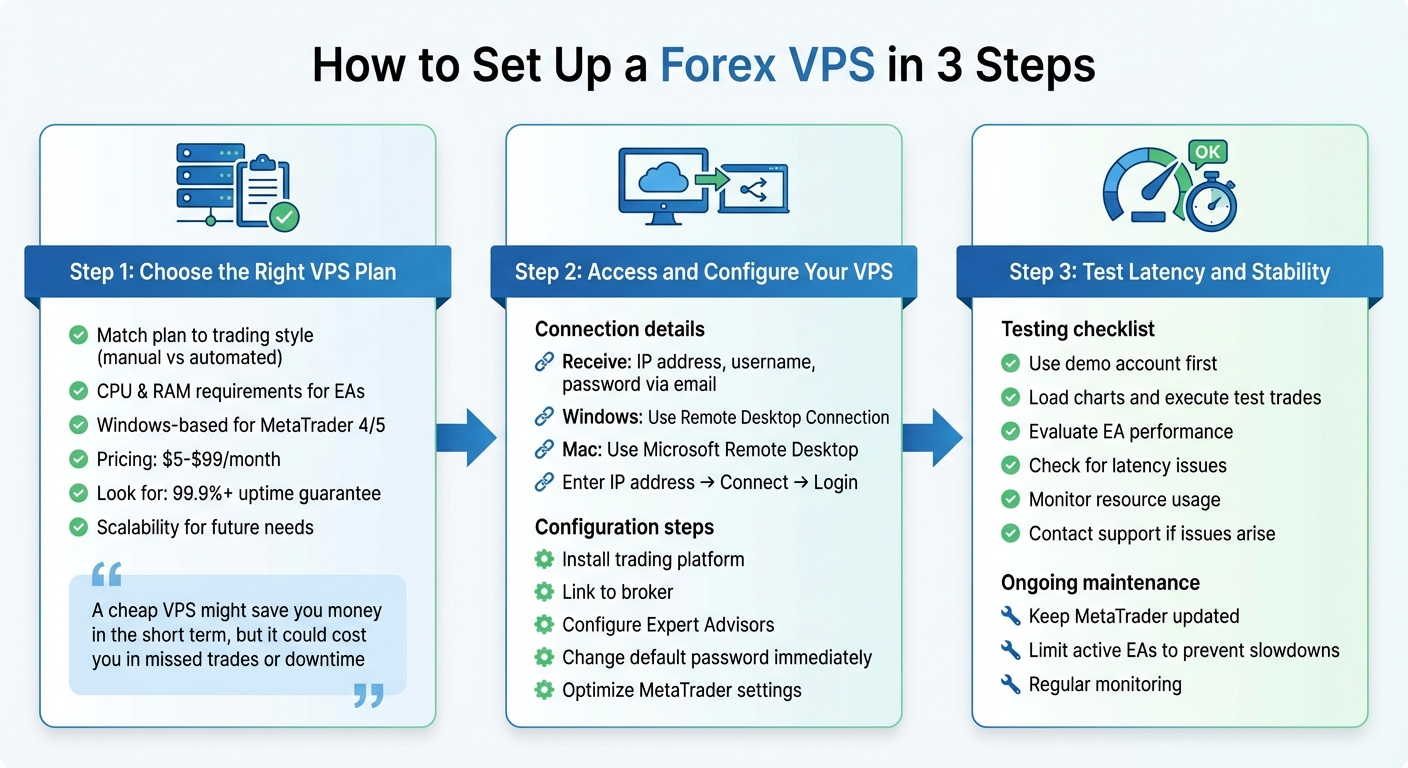
How to Set Up a Forex VPS in 3 Steps
Choosing the Right VPS Plan
The VPS plan you choose should align with your trading style. If you’re a manual trader, a basic plan might suffice. However, automated systems often demand more robust CPU and RAM to handle their processes efficiently. For high-frequency traders, the stakes are even higher – powerful specifications are crucial to ensure orders are executed quickly with minimal delay.
If you intend to run multiple trading platforms, accounts, or Expert Advisors (EAs) simultaneously, or rely on numerous charts and indicators, you’ll need a VPS plan with sufficient resources to avoid slowdowns or crashes. For Forex trading, Windows-based VPS plans are commonly recommended, especially for platforms like MetaTrader 4 and MetaTrader 5. Pricing for VPS hosting can range from $5 to $99 per month, depending on the server’s quality and specifications.
"A cheap VPS might save you money in the short term, but it could cost you in missed trades or downtime in the long run." – Liutauras Morkaitis, Customer Support Specialist, VPSForexTrader
When evaluating VPS providers, look for features like uptime guarantees (99.9% or higher), responsive customer support, and scalability to meet your evolving trading needs. If you’re uncertain about the resources you’ll require, reach out to the provider for advice or take advantage of a trial period to test their service. Once you’ve selected a plan, use the connection details provided by the provider to access and set up your VPS.
Accessing and Configuring Your VPS
After purchasing a VPS plan, you’ll receive an email containing essential login details, including the VPS IP address, username (usually "Administrator"), and password. To connect, use Remote Desktop Connection on Windows or Microsoft Remote Desktop on Mac. Enter the VPS IP address, hit "Connect", and log in using the credentials provided.
Once connected, your VPS functions like a remote Windows computer. Install your trading platform, link it to your broker, and configure your EAs. For added security, change the default password immediately. To optimize performance, adjust MetaTrader settings – for instance, reduce "Max bars in history" and disable any features you don’t use. These tweaks can help conserve your VPS resources.
Testing Latency and Stability
Before going live, it’s essential to test your VPS setup for latency and stability. Use a demo account to load charts, execute trades, and evaluate the performance of your EAs. This will help you identify any latency issues or execution delays. If problems arise, contact your VPS provider’s support team and regularly monitor resource usage.
Once you’re trading live, keep your MetaTrader terminal updated to benefit from the latest improvements. Additionally, limit the number of active EAs running simultaneously to prevent unnecessary system slowdowns. Regular maintenance and monitoring will ensure your VPS continues to perform at its best.
How to Choose the Right Forex VPS
Server Location and Latency
The location of your VPS server plays a huge role in its performance. The closer your VPS is to your broker’s servers, the lower the latency, which means faster trade execution and reduced slippage. For traders in the U.S., choosing a VPS near a financial hub like New York is a smart move if your broker’s servers are based there. This setup is especially crucial for strategies like high-frequency trading or scalping, where every millisecond counts. Pairing this proximity with solid VPS hardware ensures smooth and consistent trading.
Hardware Resources and Uptime
Your VPS needs enough CPU power, RAM, and storage to handle trading operations efficiently, even when markets are volatile. Look for providers offering plans that can scale as your trading demands grow. Uptime is another critical factor – aim for services that guarantee at least 99.9% uptime. Some high-end plans even promise 100% uptime, ensuring your trading platform stays online and reducing the chance of missed trades.
Security and Customer Support
Since your VPS holds sensitive trading data, security is non-negotiable. Opt for providers that include firewalls, antivirus protection, and regular backups as part of their service. Make sure to change default passwords immediately after setting up your VPS and keep all software up to date to fend off unauthorized access. Additionally, dependable customer support is vital. A provider offering 24/7 support ensures any technical hiccups are resolved quickly, minimizing disruptions during trading hours.
Conclusion
Key Takeaways
Using a Forex VPS can significantly enhance trading efficiency by minimizing latency and ensuring uninterrupted operations. With latency reduced to under 1 millisecond, trades are executed almost instantly, which is crucial in fast-moving markets. A VPS ensures your trading platforms and Expert Advisors stay active 24/7, so you never miss an opportunity. Additionally, these servers operate in secure environments, featuring firewalls, antivirus protection, and regular backups to safeguard your data. With uptime guarantees of 99.9% or higher, you can rely on consistent performance even during volatile market conditions. For traders using automated systems, this stability is a game changer, providing a solid foundation for optimizing your trading setup.
Next Steps for Traders
To make the most of these benefits, align your trading strategy with the right VPS plan. Consider your trading style and needs – whether you rely on automated systems, scalping, or trading during off-hours. Evaluate factors like the number of accounts you manage and your requirement for 24/7 operation. These considerations will help you choose a VPS plan with the right combination of CPU, RAM, and storage.
For a complete trading setup, pair your VPS with a high-performance desktop from DayTradingComputers. While the VPS ensures low-latency execution and uninterrupted automated operations near your broker’s servers, a powerful desktop provides the processing capability needed for detailed market analysis, backtesting strategies, and managing multiple monitors during live trading. Together, these tools create a reliable and efficient trading infrastructure tailored to your needs.
FAQs
What are the benefits of using a Forex VPS for trading?
A Forex VPS comes with several advantages that can significantly improve your trading experience. First, it ensures round-the-clock operation, which is crucial for running automated trading systems like Expert Advisors (EAs) without interruptions. This means your strategies stay active and functional at all times.
Another key benefit is the ultra-low latency connection it provides to your broker’s servers. Faster order execution reduces the chances of slippage, giving you an edge in the highly competitive Forex market.
Perhaps one of the most practical perks is the protection against power outages and internet disruptions. Even if your local internet goes down or you experience a power failure, your trading platform remains online and fully operational. For traders who value reliability, speed, and seamless performance, a Forex VPS is a game-changer.
What should I look for when choosing a Forex VPS?
When selecting a Forex VPS, prioritize reliability, speed, and security to ensure smooth trading operations. A dependable VPS should offer at least 99.9% uptime, keeping your automated trading systems, such as Expert Advisors (EAs), running without disruptions – even during home internet or power outages.
Speed and low latency are equally important for executing trades quickly. Opt for a VPS located close to your broker’s servers to reduce delays. Make sure it has sufficient CPU power and at least 2 GB of RAM to handle your trading platforms and data feeds efficiently. Adequate bandwidth is also essential for uninterrupted performance.
Don’t overlook cost and scalability when making your choice. VPS plans can range from $5 to $99 per month, so pick one that aligns with your trading budget and needs. Look for providers offering easy upgrade options as your requirements grow, robust security measures like firewalls and regular backups, and responsive customer support to address any issues promptly. Balancing these factors will help you secure a VPS that ensures fast, reliable, and secure trading.
Can I use a Forex VPS without automated trading systems?
A Forex VPS isn’t limited to automated trading systems like Expert Advisors (EAs). It offers a reliable, always-on environment for your trading platform, ensuring you stay connected to the market without interruptions. This can be a lifesaver during power outages or internet issues.
Even for manual traders, a VPS can be a game-changer. Its low-latency connection to broker servers allows for faster trade execution, making it an excellent choice for anyone who prioritizes consistency and performance in their trading.